

Home »
Maritime supplier marketing: the art of focus, consistency and persistency

Frans, founder of Getting the Market, lives and breathes maritime and logistics. He believes successful maritime supplier marketing begins with focus, consistency and persistency.
If you supply products or services to the shipping industry, you are competing with tens of thousands of companies for the same attention. Every day, shipping companies receive new pitches, new technologies, and new promises. The world runs on shipping, and everyone wants a piece of the sector.
That makes maritime supplier marketing both fascinating and challenging. It also means you cannot afford to throw your message into the wind and hope it lands somewhere. You need focus. You need clarity. You need patience. And you need to understand the industry on a level that goes deeper than vessel types and trade routes. Every maritime supplier is fighting for the same moment of attention inside a shipping company. That moment is rare. And highly valuable.
In this blog, I will guide you through the maritime ecosystem, the stakeholders that influence decisions, the personas that matter, the channels that actually work, and the mindset required to win. I will also share lessons from my years at Getting the Market, where we support maritime suppliers every single day. This is a complex sector, but that is exactly why the right approach can create serious impact.
Summary
Maritime supplier marketing is complex due to multiple vessel types, fragmented decision making, and many stakeholders such as ship owners, managers, superintendents, charterers, and class societies. Success requires sharp segmentation, clear personas, and a defined ideal customer profile. Effective channels include strong landing pages, SEO, LinkedIn ads and or other social platforms, Google Ads, industry media, events, and real case stories. The winning formula is focus, consistency and persistency. This guide explains how maritime suppliers can reach shipping companies with impact.
The shipping industry is not one market. It is many.
Open MarineTraffic and you will see vessels scattered across every ocean. Bulk carriers, tankers, container ships, RoRo vessels, offshore support vessels, dredgers, ferries, heavy lift ships, multipurpose vessels, and countless specialised ship types. The commercial fleet easily exceeds 100,000 ships.
The first mistake maritime suppliers make is treating shipping as one homogenous market. It is not. Different cargoes demand different vessels, and different vessels involve different owners, operational models, regulations, investment profiles, and procurement logic.
A 5,000 dwt shortsea bulker behaves differently from a 180,000 dwt Capesize. A coastal tanker is not the same as a VLCC. An offshore support vessel has a completely different technical rhythm than a container feeder.
This is why I always advise suppliers to pick a segment and build from there. Not everything at once. Choose your beachhead. For example: European owned bulk carriers between 20,000 and 60,000 dwt. That is already a significant and coherent target group.
Once you identify the right segment, you start speaking their language and solving their actual problems. That is the art of focus in maritime supplier marketing.
The maritime ecosystem: more complex than it looks
If you think the ship owner decides everything, you will be disappointed. Decision making in shipping is fragmented. Influence is spread across technical, commercial, and regulatory layers. Determine who the decision makers, budget holder and users are. Here are the stakeholders you must understand:
Ship owners: They hold the assets and often make the final investment decisions. Their main concerns are long term value, regulatory compliance, and return on investment.
Ship operators: They run voyages. They worry about fuel consumption, delays, schedules, and operational efficiency.
Technical managers: Often the true power players for technical products. They monitor vessel performance, maintenance costs, and operational workload.
Fleet managers: Responsible for multiple vessels. They care about standardisation, budget balance, and reliability across the fleet.
Superintendents: The practical engineers who keep vessels running. If they do not believe in your solution, nothing happens. If they trust it, they become your champions.
Captains and chief engineers: Your onboard users. If your product adds unnecessary complexity, they resist. If it makes life easier, you win allies for life.
Procurement: They negotiate pricing and terms. They rarely initiate new solutions but they can block any of them.
Charterers: Increasingly influential due to CII, ETS, and decarbonisation pressure. Their contractual demands influence technical decisions.
Shipyards: Crucial for newbuilds. If you want your system integrated at the design stage, you need early involvement.
Class societies: If class approval or certification is required, they become part of the journey and a source of credibility.
If you do not understand who influences the decision, your marketing will feel like shouting across a busy harbor. Once you do understand the ecosystem, you can speak to the right people with the right message at the right time.
The personas that matter in maritime supplier marketing
Let’s zoom in on the people behind the titles. Every maritime decision is made by humans with specific goals, constraints, motivations, and frustrations.
1. Technical Director: Often the final decision maker for CapEx. Cares about safety, reliability, compliance, and ROI. Worries about unproven technology and downtime. Responds to strong data and real-world proof.
2. Fleet Manager: Looks across multiple vessels. Cares about standardisation and operational consistency. Needs practical benefits with minimal complexity.
3. Superintendent: The engineer with grease on their hands. Cares about simplicity, installation, and maintenance. If they believe in your system, adoption becomes smooth.
4. Captain and Chief Engineer: Onboard users who want safe, simple, predictable tools. If your system makes their life easier, they become strong advocates.
5. CFO or Finance Manager: Cares about payback time, Opex savings, and long term cost control. Needs clear numbers, not promises.
6. Sustainability Manager: A fast-growing persona in 2025. Cares about CII improvement, ETS cost reduction, and decarbonisation pathways. Needs measurable impact and transparent reporting.
Every persona consumes information differently. Some read technical papers. Others rely on superintendents or LinkedIn. Tailor your message to their habits.

Image 1: Four Econowind VentoFoils (WASP) aboard the Chemical Challenger of Chemship
Maritime supplier marketing in practice: Econowind
For Econowind we built a highly segmented commercial engine. We focused on specific vessel types and geographies, created landing pages that spoke directly to bulk carriers, tankers, and general cargo vessels, and developed a fuel savings calculator for real time ROI estimation. We then drove traffic to this calculator via organic LinkedIn posts, targeted LinkedIn ads, and Google Ads. This combination brought consistent inbound traffic from exactly the right shipping companies and supported their commercial traction. It showed how segmentation and channel orchestration can create real momentum in a conservative market.
Your ideal customer profile in maritime supplier marketing
Once you understand segments and personas, define your ideal customer profile. Your ICP is the description of the companies that are most likely to buy from you, benefit from your solution, and convert into long term partners. It is the filter that keeps your marketing sharp and prevents you from wasting time on prospects that will never move.
In maritime, an ICP is crucial because the sector is enormous, fragmented, and diverse. Not every shipowner is your shipowner. Not every fleet operates the way you expect. Not every vessel type has the same needs, budgets, or regulatory pressure. A clear ICP brings discipline to your commercial strategy and aligns your marketing, sales, and product direction.
A good ICP includes:
- Vessel type
- Vessel size
- Fleet size
- Geography
- Age profile
- Technical maturity
- OpEx vs CapEx behaviour
- Retrofit vs newbuild focus
- Regulatory pressure
- Procurement style
When your ICP is clear, your messaging becomes relevant, your campaigns become cheaper, and your conversations become more meaningful. You are no longer shouting into the market. You are speaking directly to the companies that actually care.
A strong ICP saves money and accelerates results. You stop marketing to everyone and start speaking clearly to someone.
Channels that actually work in maritime supplier marketing
Let’s look at the channels that deliver results in the real maritime world.
1. A strong website with sharp landing pages
Your website is your digital vessel. It must be clear, fast, and built around the problems you solve. Good maritime landing pages include:
- The problem
- The value
- Technical details
- Class information
- Case results
- Onboard implications
- Strong visuals
- A clear call to action
Lead identification tools help your sales team understand which shipping companies are visiting your pages. For many clients, this is where the first signs of commercial traction appear.
Pro tip #1: Build pages for vessel types
Bulk carriers, tankers, container vessels, offshore vessels. People search this way. Make your content match it.
2. SEO and LLM optimisation
Search behaviour has shifted. You need content that ranks on Google and is easily understood by AI search tools like Perplexity and ChatGPT. Structured, helpful, maritime-specific content gets recommended. Want to know more about Generative Engine Optimization (GEO)? Then I highly recommend to read my colleague Joel’s blog: A maritime professional’s guide to online visibility through SEO and GEO.
Good content equals discoverability. This is especially important if you want to appear for searches like:
- fuel saving devices for bulk carriers
- agency services within a specific port
- maritime connectivity provider
- VSAT for offshore vessels
- how to improve CII
- retrofit solutions for tankers
3. Google Ads
In maritime B2B, Google Ads are not about volume. They are about relevance. A handful of highly targeted keywords can outperform broad campaigns. Exact match keywords work best. Avoid generic terms that attract irrelevant traffic.
For solutions aimed at technical managers or fleet directors, Google Ads can capture high intent traffic that is already searching for your category. Start with ten tightly defined keywords and expand only when the data proves relevance.
4. LinkedIn ads
LinkedIn remains one of the most effective channels for reaching maritime professionals. You can target:
- Fleet managers
- Technical directors
- Superintendents
- Chartering teams
- Sustainability managers
- Procurement
- Specific lists of shipping companies
It is ideal for building brand awareness, promoting case stories, and driving traffic to your landing pages or tools. LinkedIn works especially well when you speak directly to vessel types or technical roles. Specificity wins.
When you look beyond Europe, different markets require different platforms. In China, WeChat is the dominant channel for business communication. Many shipowners, shipyards, and technical managers prefer WeChat over email or LinkedIn. If you want to build visibility in the Chinese maritime ecosystem, a WeChat Official Account, localised content, and targeted community groups are essential.
The same logic applies to markets like Japan, South Korea, and India. Each has its own preferred professional platforms and digital habits. To reach maritime buyers there, you need local channels, local language, and content that respects cultural expectations. Global campaigns only work when they are supported by local presence.
An EVP that appeals to a Filipino deck officer might not resonate in the same way with a Ukrainian engineer or a Greek superintendent. Different cultures bring different values, expectations and communication styles. Some prioritise stability and family leave. Others value career growth, salary or social status.
5. Industry media
Publications like TradeWinds, Splash, Lloyd’s List, Seatrade Maritime, and Offshore Energy remain strong channels for credibility and visibility. The maritime sector trusts industry media. A well prepared story can travel far.
6. Events and in person contact
SMM, Nor-Shipping, Europort, Posidonia, Singapore Maritime Week. Shipping is still a relationship driven industry. People want to meet, shake hands, and look each other in the eye.
Preparation makes all the difference. Reach out ahead of time. Build a meeting list. Create sharp one pagers. Follow-up with the people you have met.
7. Case stories and videos
People in shipping trust what they can see, not what they are told. Real world proof is contagious in shipping. A short case story or a one-minute testimonial from a captain, superintendent, or fleet manager has tremendous power. Nothing convinces a technical manager like seeing another shipping company use your solution with success.
Pro tip #2: Let your customers speak
A single quote from a fleet manager or captain can outperform a thousand words of marketing. Shipping trusts peer proof.
8. Webinars and technical papers
Useful for complex equipment and energy efficiency solutions. Shipping professionals appreciate clear, technical, educational content.
9. Sales enablement and outbound
Marketing only works when sales is ready to continue the conversation. Tools like fleet lists, outreach scripts, one pagers, and follow up workflows make the difference between interest and opportunity.
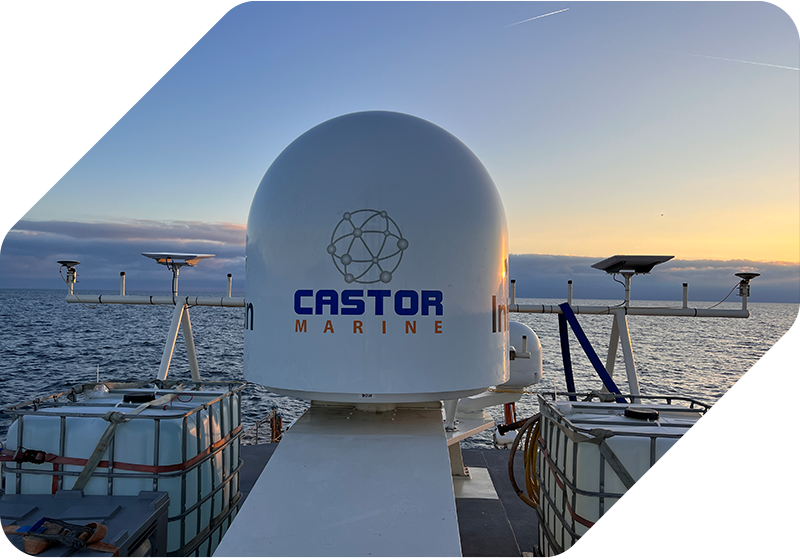
Image 2: A Castor Marine VSAT dome installed on a merchant vessel
Castor Marine example on maritime supplier marketing
For Castor Marine we strengthened their online presence as a maritime connectivity provider and supported their commercial success around selling Starlink to offshore vessels, merchant ships, and superyachts. Clear service pages, SEO optimisation, and targeted content created visibility among captains, fleet managers, and IT teams looking for reliable VSAT and Starlink installations. Online visibility helped trigger conversations that led to real conversions. Starlink is a hot topic, but visibility determines who gets the first call. Online content put Castor in that position.
The maritime supplier marketing flywheel
Marketing in shipping starts slow. It feels heavy at first. But once consistency sets in, the flywheel accelerates.
Focus
Choose the right segment(s). Choose the right personas. Choose the right message.
Consistency
Publish regularly. Show up. Stay recognisable. The market notices those who stay visible, not those who post once a quarter.
Persistency
Do not stop after two months. This sector rewards long term commitment. We see this every day. Companies that stick to the plan outperform those who jump from tactic to tactic.
Common mistakes suppliers make
- Targeting everyone
- Writing vague technical copy
- No segmentation
- Relying only on trade shows
- No case stories
- Weak website structure
- No landing pages for vessel types
- No nurturing
- Giving up too early
Avoid these, and you will already position yourself ahead of many competitors.
Pro tip #3: Marketing is relationship building
Shipping is long term. Marketing should reflect that. Give value. Educate. Show proof. Become part of the ecosystem, not just a vendor.
Conclusion
The maritime industry is vast, dynamic, and full of opportunity. But it requires a specific approach to marketing. One built on focus, consistency, and persistency. One that respects the complexity of the shipping ecosystem and understands the people behind the decisions.
If you bring clarity to your message and discipline to your execution, you will be noticed. If you speak the language of the industry, you will build trust. And if you stay committed, you will create real impact.
At Getting the Market, we support maritime suppliers every day. We know the market, the vessel types, the companies, and the people who pull the strings. We have seen this across more than a hundred maritime companies. If you want to make your mark in this sector, I would be honored to help.
Let’s connect.

Want to know more about successful maritime supplier marketing? Please contact me.
Frans Swarttouw
B2B Marketeer & Growth Seeker
Frequently asked questions
What is maritime supplier marketing?
Maritime supplier marketing is the discipline of promoting products, services, and technologies to the shipping industry. It involves understanding vessel types, decision makers, shipowners, operators, and technical stakeholders. Because shipping is highly specialised, marketing requires deep industry knowledge.
Who are the key decision makers in shipping companies?
Typical influencers include ship owners, fleet managers, superintendents, technical directors, captains, procurement teams, charterers, and class societies. Each persona has different motivations and concerns.
Which marketing channels work best for maritime suppliers?
The most effective channels include clear landing pages, SEO, LinkedIn ads, Google Ads, trade media, events like SMM and Nor-Shipping, case stories, and webinars. Combining online and offline touchpoints creates the strongest results.
How do maritime suppliers generate leads?
Suppliers generate leads by combining segmentation, targeted content, LinkedIn campaigns, Google Ads, lead identification software, case stories, and consistent outbound sales follow-up. Tools like calculators and technical papers also attract high-intent visitors.
How can shipping companies be targeted effectively?
Targeting works best when you segment by vessel type, fleet size, geography, technical maturity, and regulatory pressure. Speak directly to personas such as technical managers, captains, and sustainability managers with relevant proof and value.
How long does maritime marketing take to show results?
Shipping operates with long cycles. With a focused approach, you normally see early signs of traction after 3 to 6 months. Larger commercial outcomes often follow between 6 and 12 months, depending on segment and product complexity.


